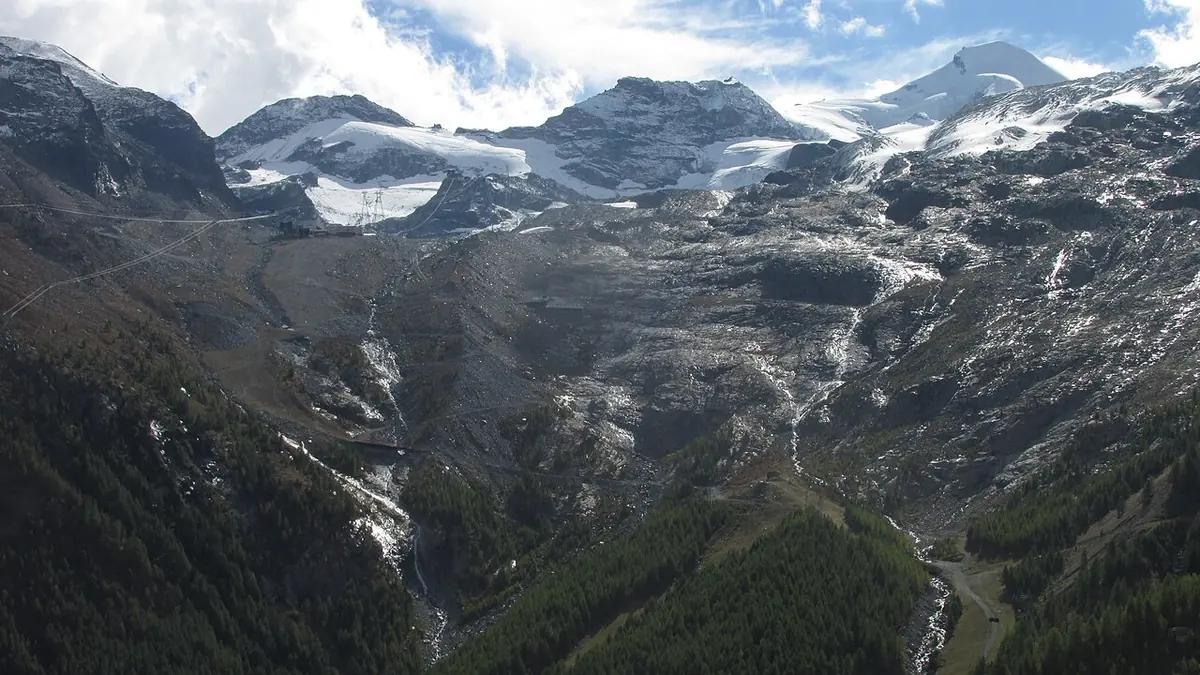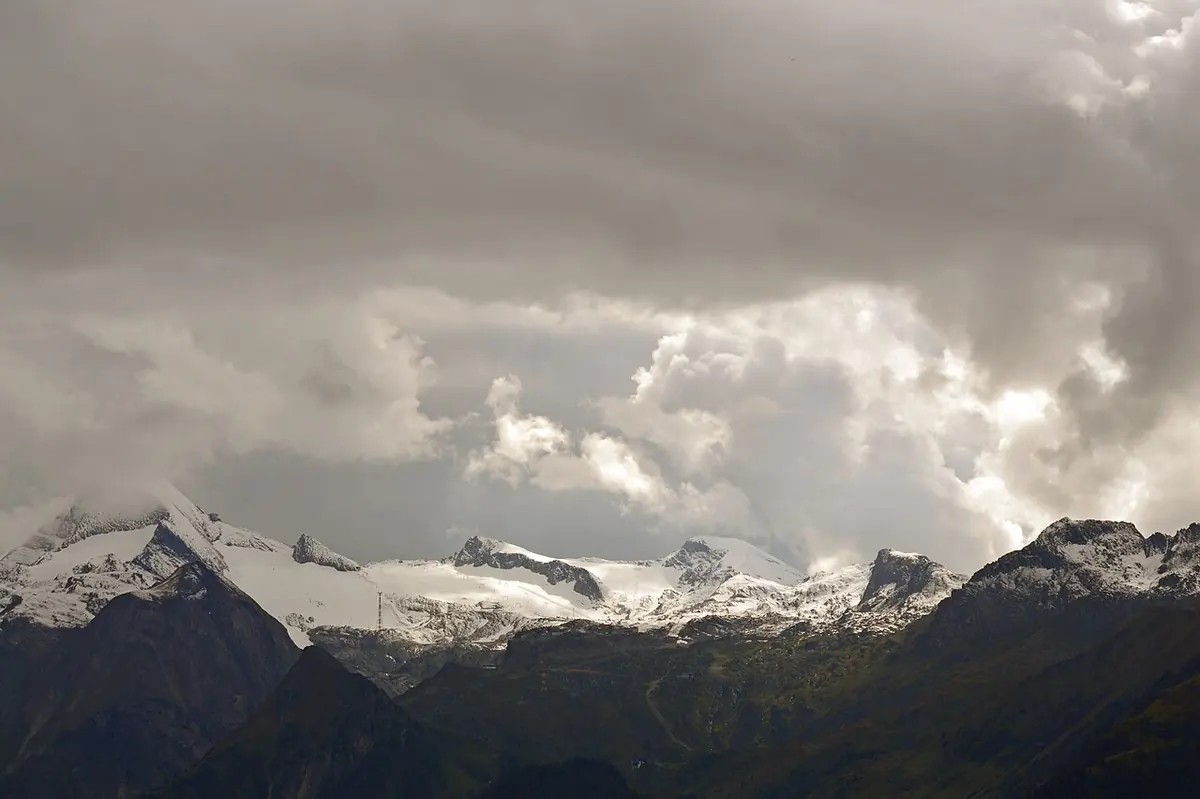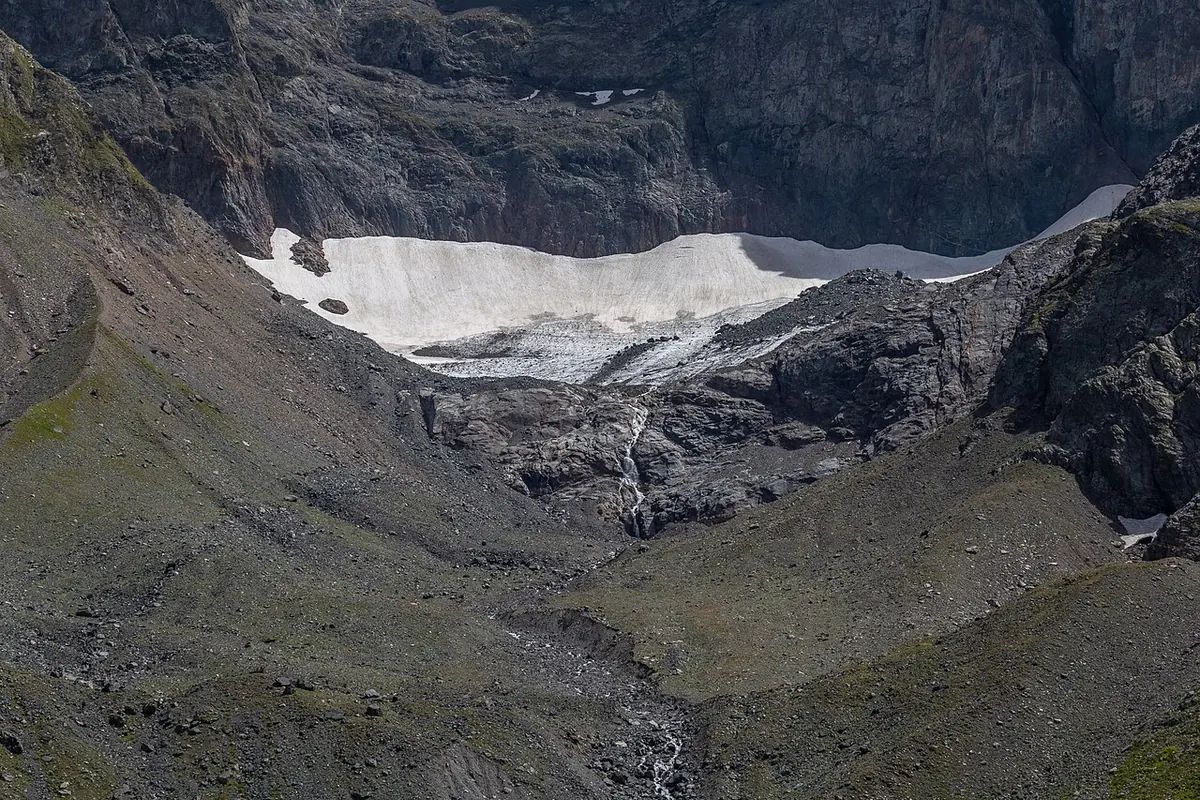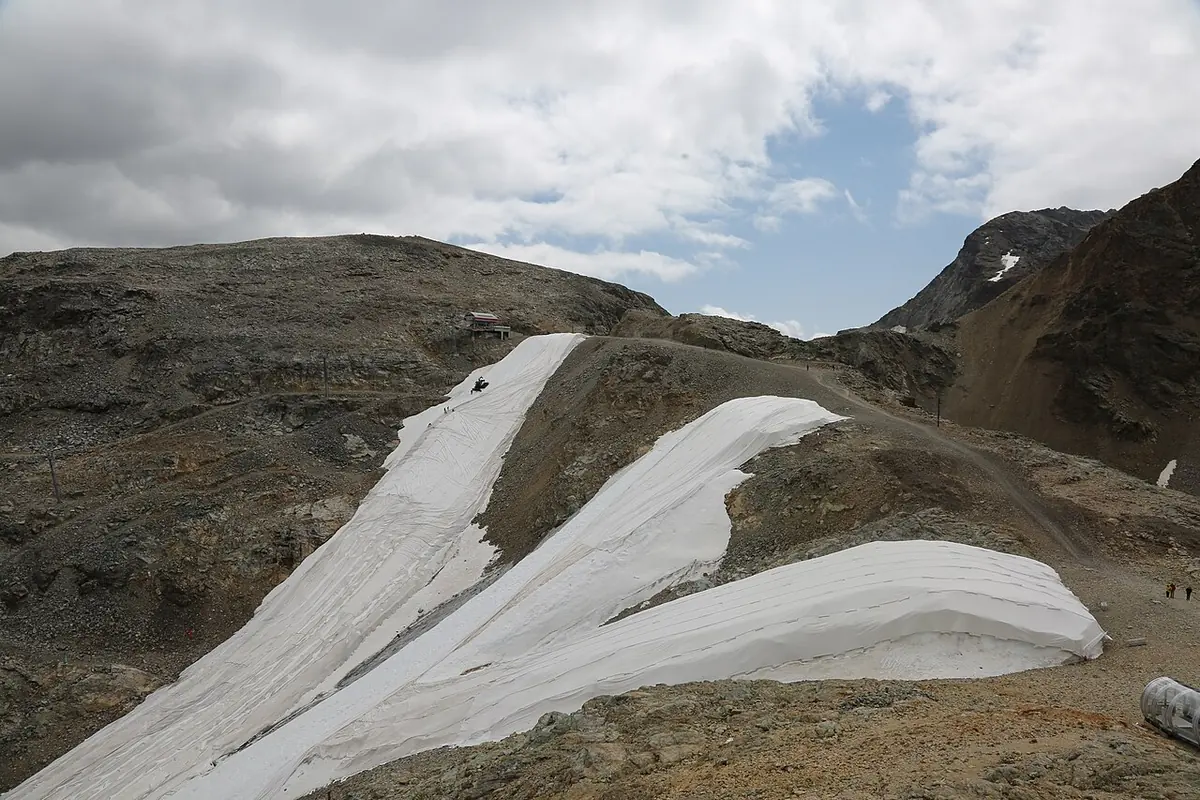
Anyone riding up to Diavolezza, Titlis or the Rhone glacier in summer will see them: white sheets laid across the ice and sewn together at the seams. They look like a field dressing, and in a sense that is what they are.
The method works. It works better than most people assume. And it changes nothing about the fate of the glaciers. Saying both at once is the honest part of this story.
What the fleece is called and what it is
The technical term is geotextile; in everyday speech everyone says glacier fleece. It is a white sheet several millimetres thick, usually made of polypropylene, rolled out in strips, sewn together and weighted down. It lies from May until late August or early September, then it is collected in.
It does two things at once:
- It reflects. White throws back a large share of the solar radiation before it reaches the ice. On a glacier, radiation is the dominant melt factor, which is why this is the decisive point here.
- It insulates. The fibre layer additionally slows heat coming in from the air.
That is exactly why fleece is right on a glacier and wrong further down. For a snow depot at 1600 metres it is useless; sawdust insulates far better there. The dividing line sits at around 2200 metres, below which air temperature matters more than sun. How that works in detail is covered in our article on snowfarming.
The effect: around 60 per cent
Various studies arrive at 50 to 70 per cent less melt under the covers, with the usual working figure around 60 per cent compared with the bare surface next to it.
The most striking single case is in the Engadin. On Diavolezza the ice has been covered for roughly two decades. After ten years the snow and ice cover at the treated spot was not thinner but around ten metres thicker than before. That is not a statistic, that is a piece of glacier that built itself up during a period in which everything around it was losing mass.
And now the scale
The same method, viewed one level up:
In numbers: around 0.18 km² of glacier surface is covered in Switzerland, which is 0.02 per cent of the total glacier area. Up to 350,000 cubic metres of ice per year are saved as a result, corresponding to 0.03 per cent of what melts away annually. On the Rhone glacier, covered on a large scale since 2010, roughly 0.3 per cent of the local ice loss was prevented over a decade.
What scaling it up would cost
The obvious question is: if it works to the tune of 60 per cent, why not simply cover more?
Because the arithmetic defeats it. The same study puts the cost at CHF 0.60 to 7.90 per year per cubic metre of ice preserved, depending on material and location. Extrapolated to all Swiss glaciers that comes to over one billion francs a year, and even that would only slow the retreat, not halt it.
For context: a billion a year is roughly the order of magnitude of the entire annual turnover of all Swiss cableway companies, which stood at 1.8 billion francs in 2025. You would have to put a good half of everything the whole industry earns onto the ice, every year.
Why it is still worth doing
The fleeces are not laid out to save the climate. They are laid out to get specific things on the mountain through the summer:
- Sections of piste and lift pylons. Where a pylon stands in ice, every metre of melt costs money and safety.
- Access to lifts and installations, which would otherwise have to be adjusted every year.
- The ice grotto at the Rhone glacier, which would long since have gone without covering.
- Summer skiing, where any is left. How little that is shows on our glacier page.
Those are operational reasons, and they are legitimate. They are simply often dressed up in a climate-protection coat that does not fit them.
The problem that went unnoticed for a long time
Polypropylene is plastic. A fleece exposed for four months to wind, rain, UV radiation and rockfall sheds fibres.
The ecologist Birgit Sattler of the University of Innsbruck investigated this and was taken aback by the scale: on one square metre of glacier ice, plastic fibres with a combined length of three kilometres were found. The material does not stay where it comes off. Wind and meltwater carry it onward, down the valley, into the water.
That leaves the method facing an awkward finding: a tool meant to protect the mountain carries microplastic into the high Alps, which is precisely where there used to be least of it.
What is being worked on
The answer to that is not abstention but different material. Two routes are being pursued:
- PLA fleece, a bioplastic made from corn starch and lactic acid, biodegradable. In spring 2025 over 20,000 m² of it were produced and delivered to five Swiss cableway companies, among them Corvatsch, Weisse Arena in Laax and Diavolezza. Corvatsch measured a snow layer 15 to 20 centimetres thicker under PLA than under the previous polypropylene. The drawback: PLA is heavier, which makes sewing and collecting it more laborious.
- Cellulose fleece made from wood fibre, being researched in Austria.
Neither is yet the norm, but the direction is right: the problem is not being disputed, it is being solved at the material.
What remains
Three sentences that together make up the whole story.
Fleece works. Sixty per cent less melt is a large effect, and on Diavolezza you can pace it out.
Fleece does not scale. 0.02 per cent of the area, over a billion francs a year for the rest. Anyone selling the method as an answer to glacier retreat is not doing the sums.
Fleece has a price that does not appear on the invoice. Three kilometres of fibre per square metre is not a rounding error, and the replacement material is only on its way.
What that means for individual resorts, and which glacier ski areas are even left, is on our glacier page.
As of 10 August 2026.
Sources: WSL: covering glacier ice effective but expensive (60 per cent effect, 0.18 km², 350,000 m³, CHF 0.60 to 7.90 per cubic metre, over a billion a year; study led by Matthias Huss, WSL / ETH Zurich / University of Fribourg, Cold Regions Science and Technology); GlaciersAlive (Diavolezza, PLA fleece 2025, Corvatsch measurements); higgs and swissinfo (range of 50 to 70 per cent, share of total loss, Rhone glacier); research by Birgit Sattler, University of Innsbruck, on fibre abrasion, reported in the Tiroler Tageszeitung and by ORF Tirol; industry turnover 2025 per Seilbahnen Schweiz.