In April a snow groomer in Davos pushes the snow of the past season into a single pile, tips 30 to 40 centimetres of sawdust over it and leaves it there. A spring, a whole summer and half an autumn go by. At the end of October the sawdust is scraped off, and underneath, around 80 per cent of the snow is still there.
This is not a trick and not marketing. It is physics, and the physics is surprisingly plain.
What snowfarming is
Snowfarming means keeping snow rather than making it again in autumn. The sequence is always the same.
- Push it together. In spring, when the season ends, the remaining snow is pushed into a compact depot on a shaded, level site. The denser the pile, the smaller its surface relative to its volume, and the surface is the only part that melts.
- Cover it. An insulating layer goes on top. Sawdust or wood chips in the valley, white geotextile fleece high up. Which of the two is right depends on altitude, and the line is surprisingly sharp. More on that in a moment.
- Leave it alone. Over the summer the edges melt away, the core stays.
- Spread it out. In autumn the sawdust is removed and the snow distributed, usually onto a cross-country trail or a short strip of piste.
Why sawdust and not simply a white tarpaulin
The obvious thought is: white reflects, so use something white. For a glacier at 3000 metres that is correct. For a pile of snow at 1600 metres it is wrong, and the first attempt in Davos demonstrated that expensively.
2008, Flüela valley, two piles side by side. One under fleece, one under sawdust. By the end of the summer the fleece pile was essentially gone. Under the sawdust, around 30 per cent was missing.
The reason lies in what actually causes melt at which altitude. High up, solar radiation is the main enemy, and a bright, reflective cover works against it. Lower down it is warm air, and reflection does nothing against warm air. There you need a thick, insulating layer that absorbs and dissipates heat radiation. A second effect comes on top: wet sawdust evaporates, and evaporation costs energy. That energy is drawn from the surroundings. The layer cools itself.
The dividing line sits at roughly 2200 metres. Above it fleece wins, below it sawdust. That is not a rule of thumb from practice but a result of the research accompanying the Davos depot.
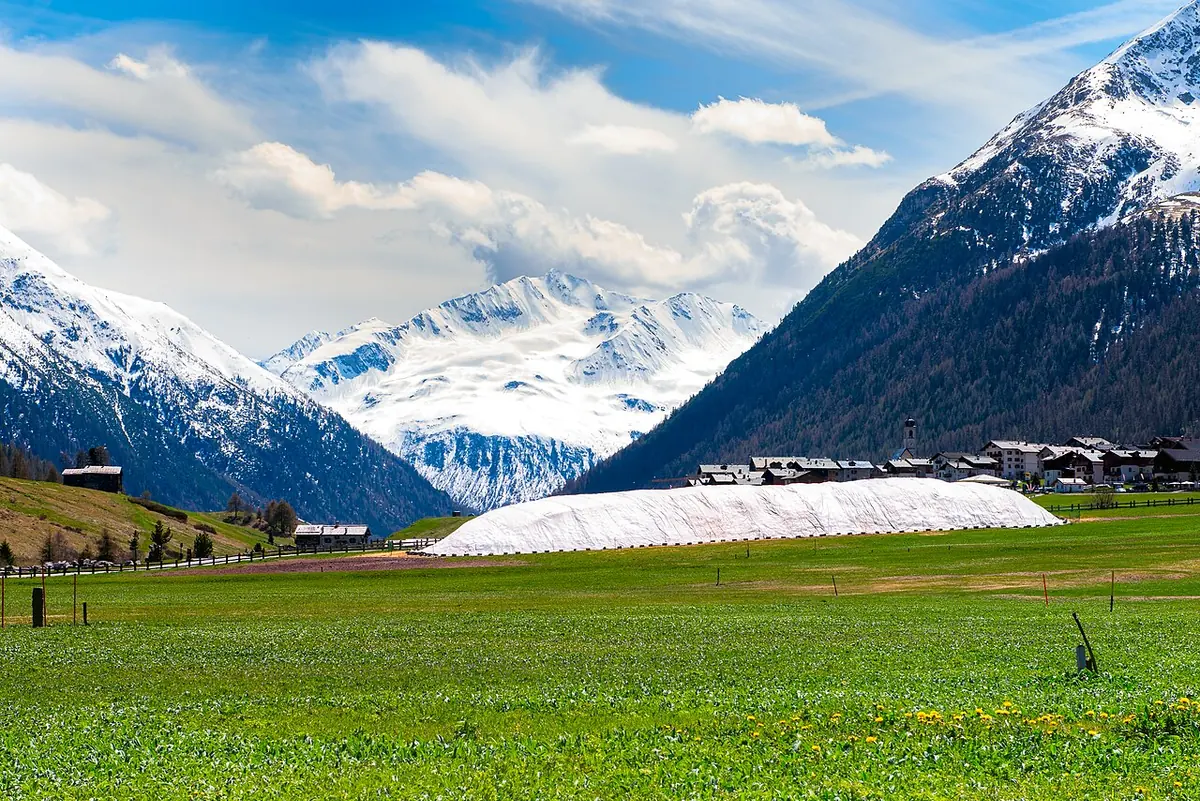
Practice does not follow this everywhere, and the photo at the top of this article shows it: Livigno sits at a good 1800 metres and still covers its depot with a white sheet rather than sawdust. The reason is not physics but handling. Sawdust has to be hauled in by the lorry-load, scraped off again in autumn and disposed of. A sheet gets rolled up. Anyone unwilling to take on that effort accepts the poorer insulation and stores a larger depot to compensate.
What is left
How much piste that actually makes
This is where it gets interesting, because the cubic metre figures sound like more than they are. Let us work it through.
Davos stores 20,000 m³. After 20 per cent loss, around 16,000 m³ remain. A cross-country trail is about six metres wide, and a load-bearing layer is roughly half a metre deep. That gives:
16,000 m³ divided by (6 m × 0.5 m) = a good 5 kilometres of trail.
For a piste the sum looks different, because a piste is far wider. One kilometre of piste covers around 3.2 hectares, and a 30-centimetre base layer needs 3000 m³ of snow per hectare. That is 9600 m³ per kilometre. So 16,000 m³ becomes just under 1.7 kilometres of piste, and the depot is empty.
Kitzbühel provides the cross-check, and it adds up cleanly. Around 24,000 m³ are stored there, the loss stays below 20 per cent, and the result at the start of the season is a strip 700 metres long and 60 metres wide. Doing the arithmetic: 19,200 m³ over 42,000 m² is 46 centimetres of depth. Exactly the order of magnitude of a base layer. The figure holds up.
That also settles what snowfarming is and is not. It is the first kilometre, not the ski area. It saves the season opening, the training operation and a race in November. It does not save a winter.
Who does it
| Place | Volume per year | For what |
|---|---|---|
| Davos | around 20,000 m³ | cross-country trail, season opening in late October, since 2008 |
| Kitzbühel | around 24,000 m³ | strip of piste 700 × 60 m for the season opening |
| Seefeld in Tyrol | around 6,000 m³ | cross-country trail, since 2015 |
| Ramsau am Dachstein | no figure given | trail at the nordic centre |
| Livigno | no figure given | trail and training loop |
| Oberhof (Germany) | no figure given | biathlon course |
In Switzerland Davos is the best-known case but not the only one: depots also exist in the Engadin and in the Bernese Oberland, for instance on the Tschentenalp above Adelboden. The basic idea is the same everywhere, only the scale differs.
The part that rarely gets discussed: energy
Snowfarming is usually sold as a snow guarantee. The stronger argument is a different one.
Snow can only be made in the cold, and the scarcer the cold, the more expensive every cubic metre becomes. A system working against the limit in November at minus two degrees and high humidity consumes a multiple of what the same system needs in January at minus ten degrees and dry air. The figure from practice: under good conditions a cubic metre of snow costs around one third of the energy of autumn production at the margin.
That inverts the logic, and you can do the arithmetic. Producing one cubic metre in October at the margin costs three units of energy. Producing the same cubic metre in midwinter and storing it means making 1.25 cubic metres to allow for the loss, but at one unit each, so 1.25 instead of 3. Even with a fifth lost over the summer, stored snow is the cheaper option, and by a wide margin.
How much electricity and water snowmaking needs overall, we worked out in a separate article.
And a detail from the fine print
The Grisons guidance for snowmaking installations requires the ground to be frozen where possible, so that it does not erode. Then comes an exception, and it applies to precisely the subject of this article: “except for snowmaking to build snow depots”.
So anyone producing snow in spring or autumn for a depot is exempt from the frozen-ground rule. The reasoning is sound: a depot sits in one place, nothing is skied there, and the snow only reaches the actual slope later. What other rules apply to snowmaking, in Switzerland and in Austria, is covered in our article on snowmaking regulations.
What snowfarming does not solve
Three limits that glossy coverage tends to leave out.
- It needs a suitable site. Level, shaded, reachable by heavy machinery. Not every resort has one.
- The sawdust has to come off again. It is removed in autumn and either disposed of or reused, and both cost labour and money.
- The scale stays small. A depot covers something on the order of one to two kilometres of piste. A mid-sized Swiss ski area has 30 to 50.
Snowfarming is therefore no antidote to warmer winters. It is a very good tool for a very precisely defined problem: the first few weeks, in which training, racing and the season opening depend on snow that the weather has not yet delivered.
As of 10 August 2026. The conversions from cubic metres into trail and piste length are our own calculations from the figures cited and should be read as orders of magnitude.
Sources: SRF Meteo on snowfarming in Davos (Flüela valley trial 2008, sawdust layer, the 2200-metre line, energy comparison); Davos Klosters (depot volume and season opening); Skigebiete-Test on snowfarming in Kitzbühel (24,000 m³, losses, piste dimensions); Olympiaregion Seefeld (6000 m³ since 2015); Office for Spatial Development of the Canton of Grisons, guidance on snowmaking installations 2007 (exception for snow depots). Snow volumes per hectare from our own calculation on machine-made snow.