It is the only Olympic sport you can practise on any given Tuesday evening without booking a facility: walking uphill on skis.
At the 2026 Winter Games in Milano Cortina, ski mountaineering appeared on the Olympic programme for the first time, known internationally as skimo. And the opening went as well as it possibly could for Switzerland.
What happened
Two medals from two events in which Switzerland was involved. Led by Rémi Bonnet, Switzerland also secured victory in the World Cup nations’ ranking once again.
That Switzerland leads here is no accident. Ski mountaineering racing grew up in the Alpine countries, and Switzerland, with its vertical races and an active scene around the SAC, has one of the deepest youth bases.
What the sport is
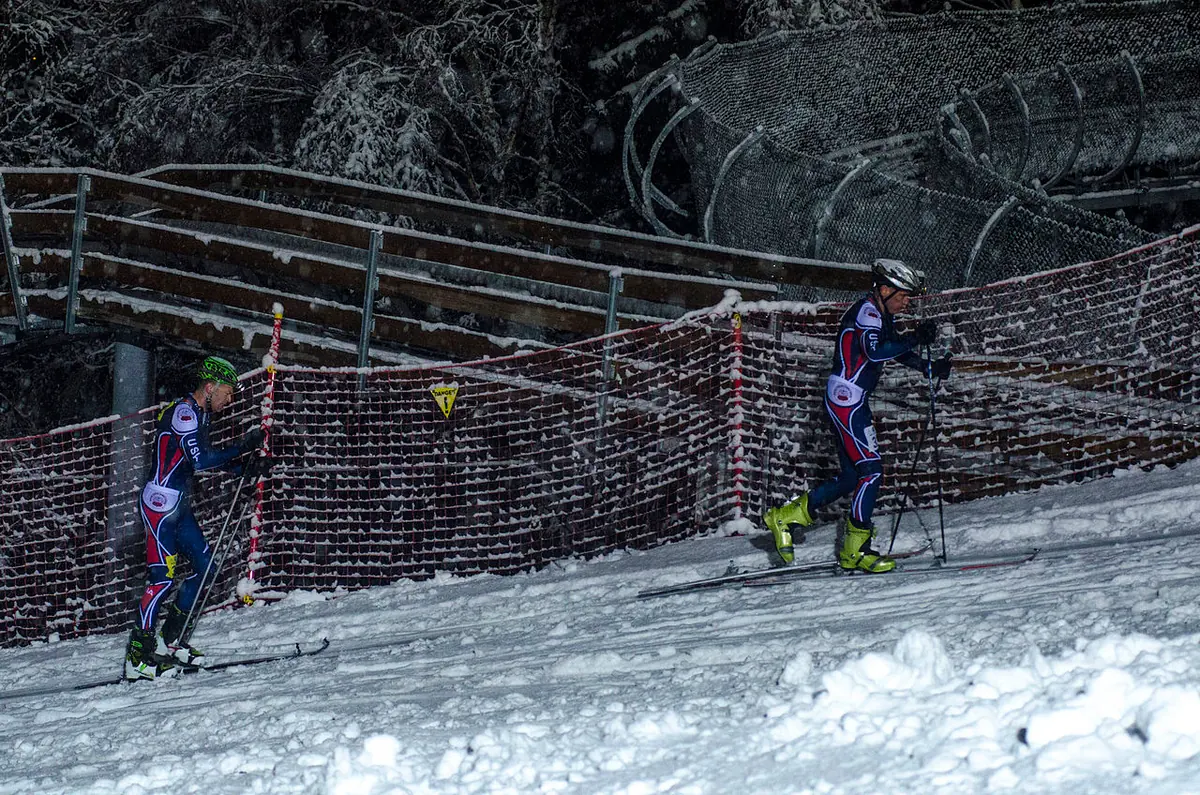
The Olympic sprint lasts a few minutes and contains, in compressed form, everything that makes up a ski tour:
- Ascent on skins, as fast as possible.
- Stripping the skins under time pressure, a manoeuvre that decides seconds.
- A section with skis on the pack, on foot.
- Descent without skins to the finish.
Anyone who has peeled skins with numb fingers at the top of a tour knows every one of those steps. The difference is the pace and the equipment: race skis weigh under a kilo, the boots are carbon shells, and the whole set-up is built for weight rather than descent performance.
The difference from a ski tour, which is worth knowing
Here is where a misunderstanding can form, and it is one with consequences.
A ski mountaineering race takes place on secured or selected terrain. The course is set, checked, and closed or rerouted in case of doubt. The athletes make no decision en route about whether a slope will hold, because that decision was taken beforehand by the race organisers.
An ordinary ski tour in the backcountry is the opposite. There, every group makes that decision itself, with no race organisation and no marked track. Last winter cost 146 lives in Europe, a large share of them experienced tourers.
So the Olympic sport shows the physical half of ski touring in pure form and leaves out the judgement half. That is not a criticism of it; it is what a competition is. But nobody should infer one from the other.
Anyone wanting the competition part without the risk part will find it exactly so: as a piste tour on a groomed, open piste. That is essentially the Olympic discipline, and what applies there is in our piece on it.
Why this became Olympic now
Ski mountaineering racing is not a new sport. Its international federation has existed since the early 2000s and world championships for decades. Its admission to the Olympic programme has several causes, and one of them is the same one that just brought freeride in for 2030: the sport needs no venue.
A ski mountaineering race takes place on a slope. It needs no bobsleigh track, no ski jump and no speed-skating hall, that is, none of the structures that remain as expensive ruins after the Games. For an IOC that has had a sustainability problem on its balance sheet for years, that is a strong argument.
Then there is the growth. Ski touring is the fastest-growing winter sport in the Alps, and not as a competition but as a mass participation activity. The Olympic appearance is the tip of that, not the cause of it.
What is likely to follow
An Olympic gold in a sport you can try on hired equipment after work lands differently from one in skeleton.
More people can therefore be expected to try it, and that is fundamentally good news. The sport is healthy, cheap compared with lift skiing, and in its piste form essentially free of danger.
The condition is set out in our introductory piece and can be summed up in a sentence: the route runs via the piste and via a course before it runs into the backcountry. Anyone who keeps to that order is practising one of the safest mountain sports there is. Anyone who skips it ends up in the statistics we otherwise analyse in this section.
Sources and caveats
- Swiss Alpine Club SAC, reports on the Olympic debut of ski mountaineering at the Milano Cortina 2026 Winter Games: gold for Marianne Fatton in the sprint, silver for Marianne Fatton and Jon Kistler in the mixed relay behind France. Swiss victory in the nations’ ranking, led by Rémi Bonnet.
- Format of the sprint according to the SAC’s description: ascent on skins, carrying section with skis on the pack, descent without skins.
- The assessment of the reasons for Olympic admission, in particular the absence of venue requirements, is our own presentation and draws on the argument the IOC also advanced when admitting freeride for 2030.
- Figures for the weight and construction of race equipment are orders of magnitude from the competition scene, not manufacturer specifications.
This piece reports on a competition. Ski touring in the backcountry requires training with the SLF and the SAC; a race on a set course is no benchmark for it.