Anyone buying ski touring or freeride equipment for the first time faces a wall of devices and a price range from four hundred to over two thousand francs. The question rarely answered clearly is not “which model” but: what does each of these things actually do, and in what order?
We have gathered the Swiss prices and set out alongside them which job each item performs in the chain of an accident.
The prices
Guide figures from Swiss specialist retail for the 2025/26 winter.
What each item does
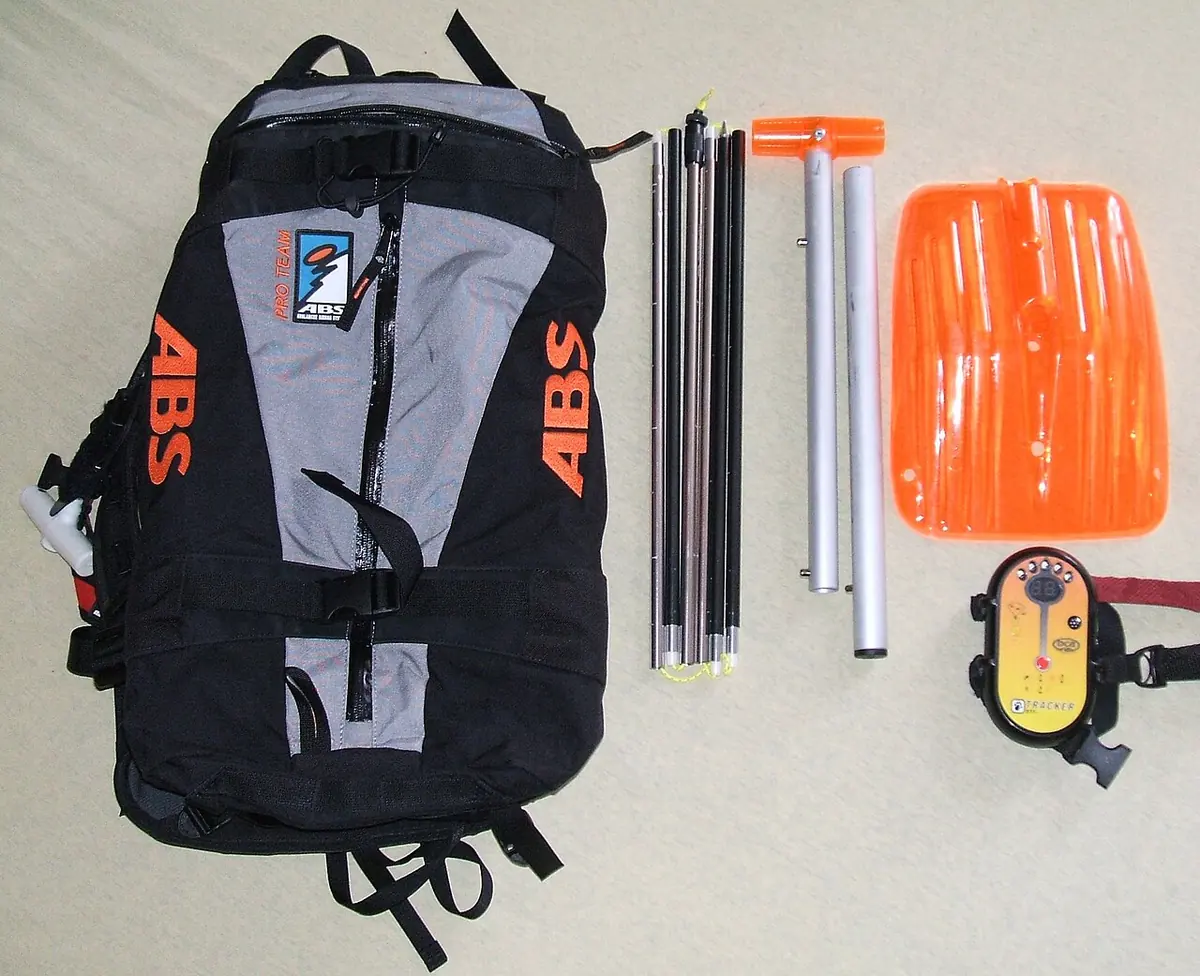
The three basic items tend to be named in one breath, as though they were a single device. They have separate jobs, and they come into play one after another.
| Item | Job | When it works |
|---|---|---|
| Transceiver | send a signal, and search | coarse, down to a few metres |
| Probe | find the point and the depth | fine, to the centimetre |
| Shovel | move the snow | afterwards, and this is the long part |
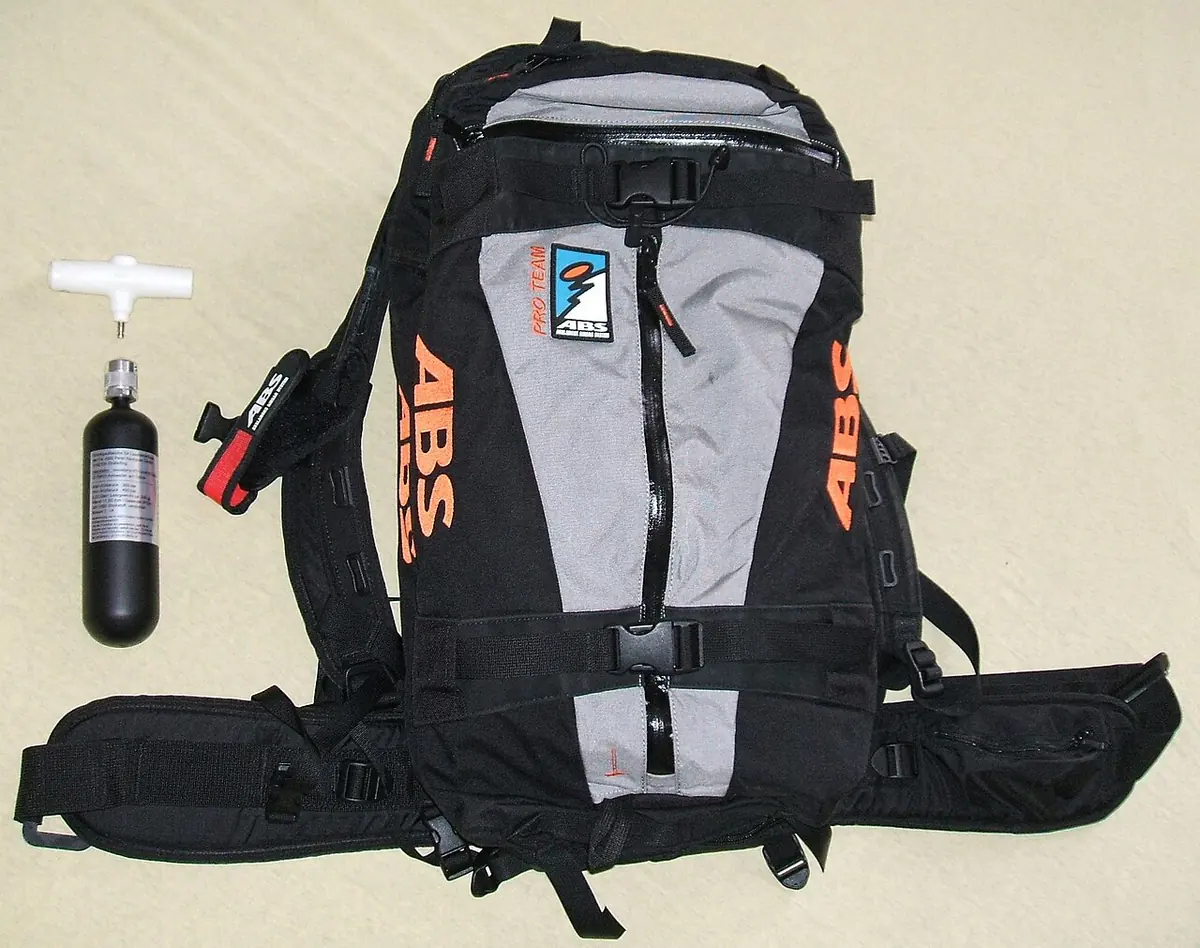
| Airbag | prevent complete burial | beforehand, during the ride |
The transceiver sends while it is switched on and searches once you switch over. It brings you to within a few metres of the buried person, no closer. Three antennas are standard today, and that is not a marketing detail: older one- and two-antenna devices search markedly worse with multiple burials and in awkward orientations. Anyone handed a second-hand device should check that above all.
The probe is the cheapest item and the one most often missing. Without it you dig in the wrong place and, more seriously, at the wrong depth. It settles both within seconds.
The shovel is the most underrated item in the set. The reason is arithmetic: at one metre of burial depth, roughly a tonne of avalanche snow has to be moved, and avalanche snow is not powder but compacted and hard. Hence aluminium and not plastic. A plastic shovel breaks in hard avalanche debris, and it breaks precisely when it matters.
The second figure to go with it: digging time does not rise in proportion with depth but faster. At two metres it is not double the volume but roughly four times.
The order that explains the prices
The division of jobs implies a ranking that contradicts the price tags.
First the three basic items, complete. A transceiver without a shovel is a device with which you find somebody and then stand next to them. The combination is the point, not the individual item. This is why sets make sense, and why it is pointless to spend 200 francs more on the device and leave out the probe.
Then the practice. A new device that has never been used searches more slowly than an old device in practised hands. Where you can practise free of charge is set out in our overview of avalanche training centres: over twenty Swiss areas have a facility, usually free with a valid lift pass.
Last the airbag. It is the most expensive item and the one with an entirely different job: it is meant to prevent complete burial, not to resolve it. The evidence for it is well studied and less clear-cut than the advertising suggests; we have worked through it separately.
What else belongs, and is rarely mentioned
A first-aid kit and a survival blanket. Someone dug out is hypothermic and often injured. The time until organised rescue arrives has to be bridged, and that is usually the longer part of the operation.
A charged phone and the emergency numbers. In Switzerland that is Rega on 1414, in Europe 112. A phone in an outer pocket at minus ten degrees is flat after two hours.
Batteries, not rechargeables. Most transceiver manufacturers specify alkaline cells. Rechargeable cells hold their voltage differently and can render the device’s remaining-charge display useless, which is worse than a weak battery: you then rely on a number that is wrong.
What the equipment cannot do
For completeness, and because this is the most important paragraph here.
All of this equipment acts after the release. It changes nothing about the probability that a slope fails. Anyone who skis a slope with a complete kit that they would have avoided without one has increased their risk, not reduced it.
And it only works in a group. A transceiver sends a signal that somebody has to receive. Alone in the backcountry it is a device that helps locate the body after the accident. That appears in no product description and is nonetheless the condition on which the entire calculation rests.
Why time decides everything here is set out in our piece on the first 15 minutes.
Sources and caveats
- Prices: Bächli Bergsport and other Swiss specialist retailers, as of August 2026. Transceivers: Ortovox Diract Pro CHF 245, Ortovox Diract Voice CHF 265, Mammut Barryvox 2 CHF 359, Mammut Barryvox S2 and Pieps IPS CHF 449 each. Complete set from CHF 579. Airbags: cartridge system from CHF 559, electronic system around CHF 1,029. Guide figures that vary considerably with model year and discount.
- Composition of the emergency kit follows the consistent recommendation of the SAC and specialist retail: transceiver, probe, shovel, first-aid material.
- The tonne of snow at one metre burial depth is a rough calculation using a density typical of avalanche debris and a digging area of a few square metres. It is meant to show the order of magnitude, not to describe an individual case.
- On airbag effectiveness see our separate assessment; the underlying study dates from 2014.
This piece describes what the devices do and is not training. Handling them is practised, not read. Courses are run by the SLF and the SAC.