Avalanche research has few charts that get shown as often as this one. It plots how likely a completely buried person is to survive against the time spent under the snow. The curve is not a straight line, and that is the whole of its message.
Show the figures as a table
| Minutes | Survival probability |
|---|---|
| 0 | 100 % |
| 15 | 92 % |
| 18 | 91 % |
| 25 | 52 % |
| 35 | 31 % |
| 60 | 26 % |
| 120 | 21 % |
What the three phases mean
Up to about 18 minutes almost nothing happens. Anyone dug out within that window survives with roughly 90 per cent probability. Snow is permeable enough to breathe through, as long as mouth and nose are clear or a cavity exists.
Between 18 and 35 minutes the curve collapses. From around 90 to around 30 per cent. This is the stretch in which most of those who die suffocate. Exhaled carbon dioxide accumulates in the surrounding snow, the air being drawn in gets worse, and the snow in front of the face ices over from breath moisture into a dense mask.
After 35 minutes the curve flattens. It keeps falling, but slowly, to a little over 20 per cent. Those who reach this phase generally have a cavity in front of the face and a clear airway. They no longer die of oxygen deprivation but slowly of hypothermia.
The arithmetic that follows
This curve is why avalanche rescue carries a statement that would sound alien in any other emergency service: organised rescue almost always arrives too late.
That is not a criticism of rescue services but arithmetic. The sequence is fixed, and every step takes time:
- The avalanche comes to rest.
- Somebody notices the burial and raises the alarm.
- The alarm is taken and passed on.
- A crew launches and flies in, in winter and often in difficult weather.
- At the site, the buried person still has to be found.
Even if every single step runs smoothly, the eighteen-minute window has in most cases long closed before step four is complete. In practice, more time regularly passes between the avalanche and the arrival of a helicopter crew than the curve leaves available.
We have deliberately not put an average Swiss response time here: we found no robust, publicly documented figure for it, and an estimate would be the worst possible thing at this point. The argument does not need one; it follows from the order of the steps.
Hence the real consequence. The only rescue that statistically arrives inside the window is the one carried out by the people standing next to you. Everything carried as equipment serves that single task.
What people die of in avalanches
Here it gets interesting, because the figures from different sources do not agree, and we do not want to smooth that over.
Most victims suffocate. But a substantial share, between one in seven and one in three depending on the source, dies of the injuries sustained in the avalanche itself: impact with rocks and trees, falls over terrain edges, injuries from their own equipment.
That share is the most uncomfortable number in the whole statistic, because fast rescue cannot influence it. Anyone fatally injured during the ride is dead before the curve above even begins. No transceiver and no shovel changes that.
Why the figures diverge is open to informed guesswork: cases are recorded differently, not every death is followed by an autopsy, and terrain types differ between countries. We cannot say for certain.
What decides between living and dying
Studies of complete burials pull out three factors, and they act together rather than singly:
Burial duration has the strongest effect, and it is the only one that companions can still influence after the event.
Burial depth. It works twice over: buried deeper means less air exchange with the surface and, at the same time, a great deal more snow to be moved. Digging time does not rise in proportion with depth but faster.
The cavity in front of the face. Whether one exists decides whether somebody reaches the phase beyond 35 minutes at all. It forms by chance, according to body position at the moment everything stops.
In the Swiss long-run statistics, around half of all people completely buried in the backcountry survive. That sounds like a coin toss, and at its core it is one: half the outcome is settled before anybody starts to dig.
What the curve says about equipment
Without turning into a manual, the shape of the curve yields a logic that explains why the standard kit looks the way it does.
It falls into two classes with quite different jobs.
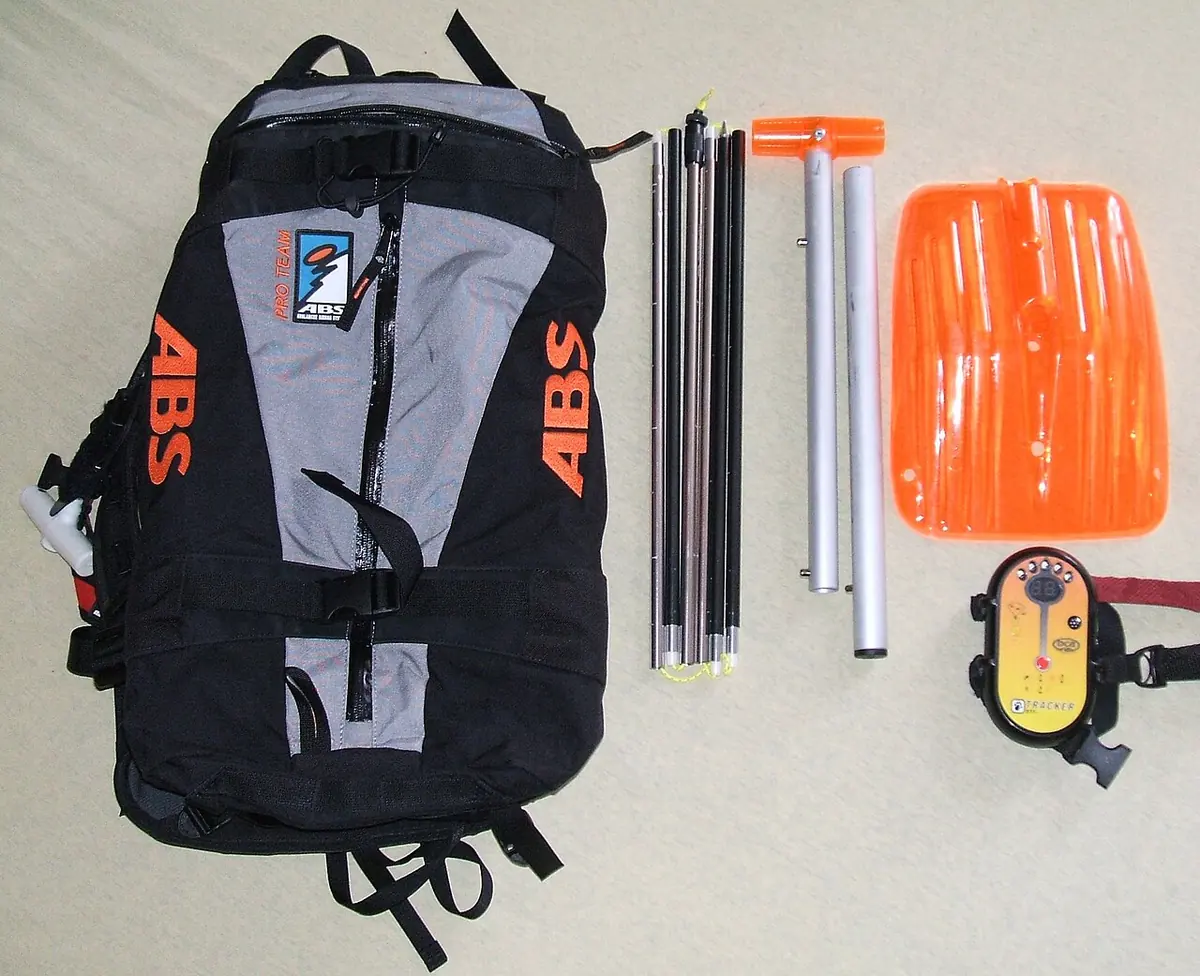
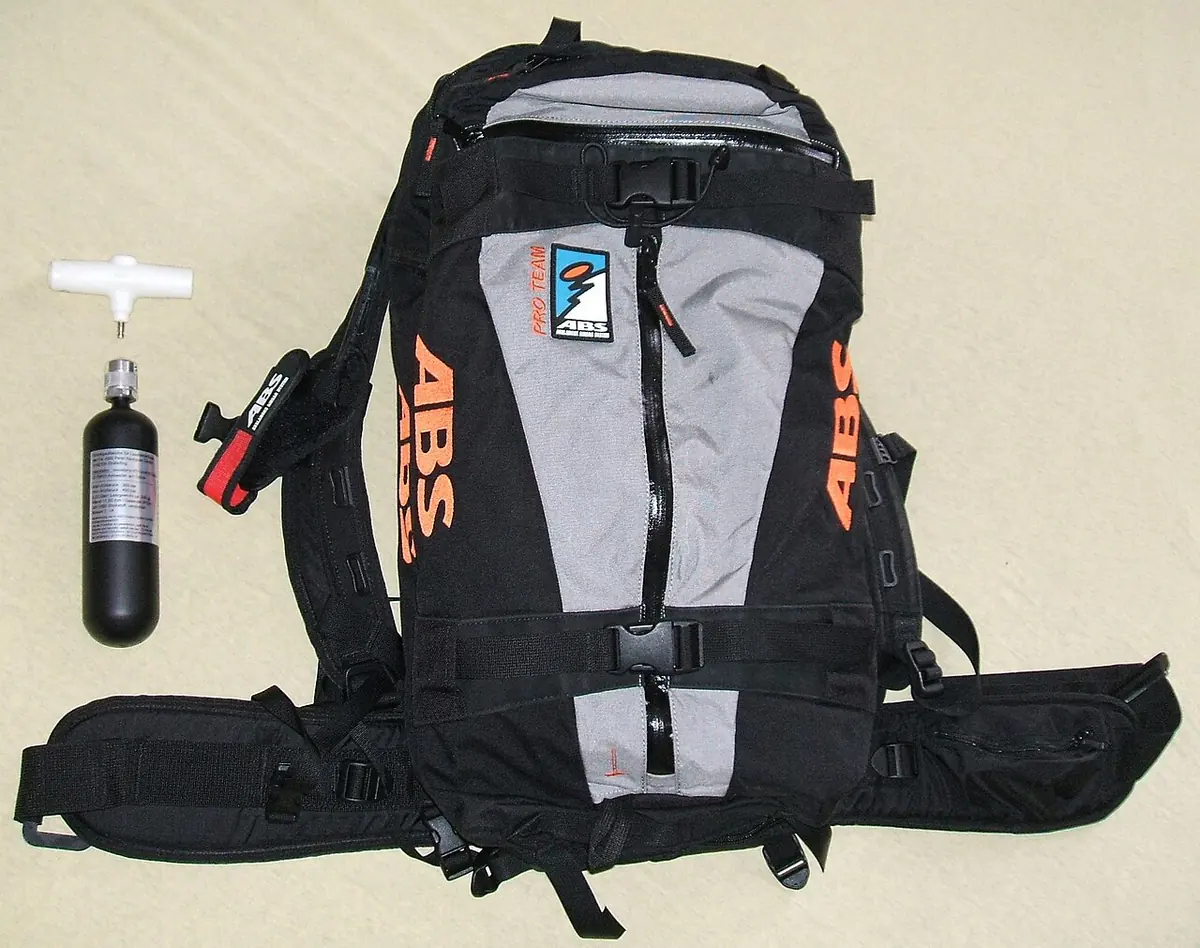
Preventing complete burial in the first place. This is where the avalanche airbag sits. It acts before the curve, not inside it: someone who is not completely buried never enters this statistic at all.
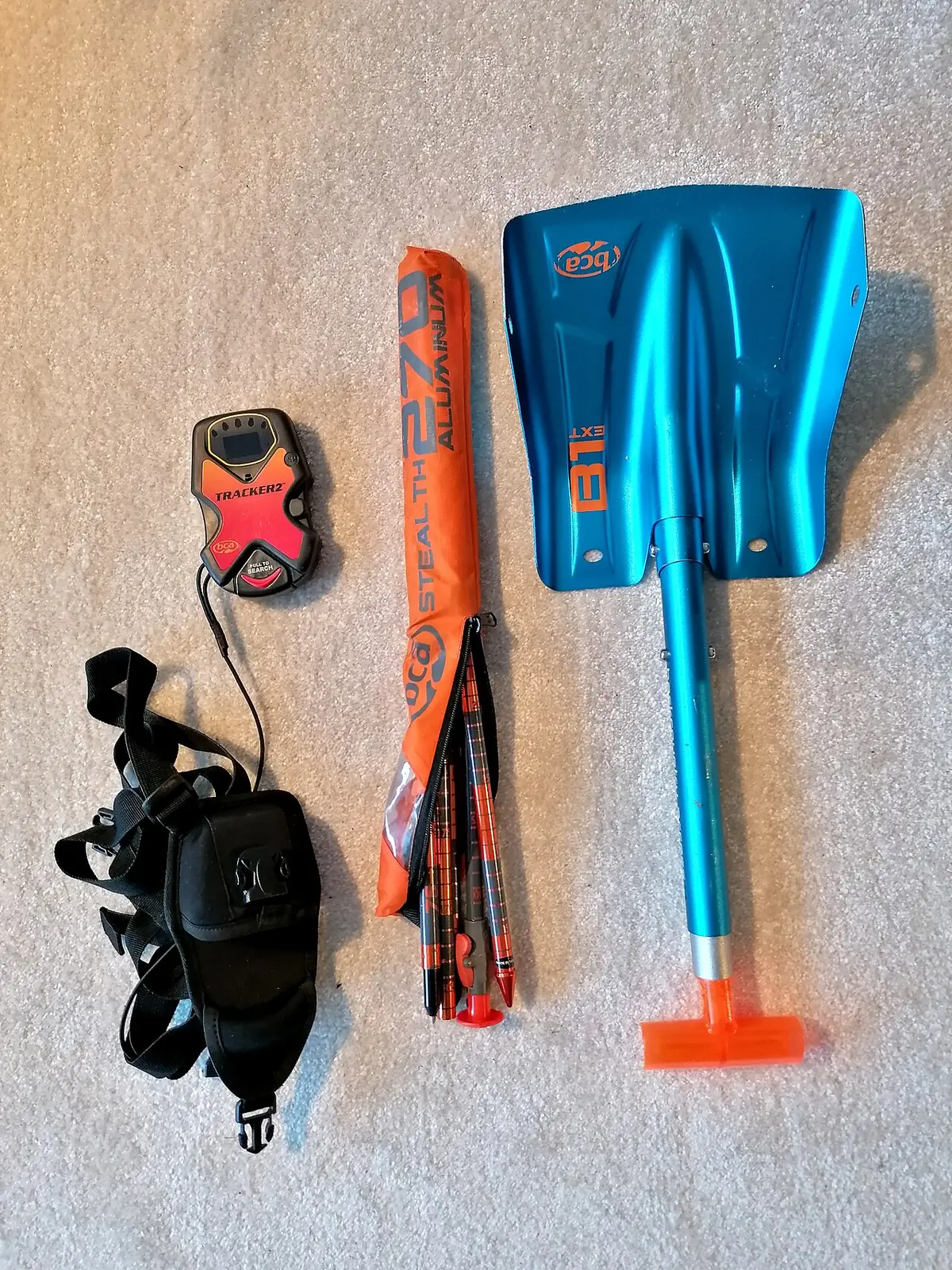
Shortening the time spent inside the curve. This is where the transceiver, probe and shovel sit. They do not make burial less likely; they only shift the moment of extraction to the left. That is exactly where the curve is steepest, and therefore where the gain is largest.
There is no third class: nothing in the equipment meaningfully lengthens the window itself.
What all this costs to buy, and how the devices differ, we will work through separately. How a weak layer forms that triggers such accidents in the first place is covered in the persistent weak layer explained, and how last winter looks in figures in our avalanche review 2025/26.
Sources and caveats
- Survival curve after Falk and Brugger, the standard reference on survival probability in avalanche burial, based on data from Switzerland, Austria and Canada. Documented: around 90 per cent survival for recovery within 15 to 18 minutes, and around 30 to 35 per cent after 35 minutes.
- SLF, long-term statistics: around 50 per cent survivors among those completely buried in the backcountry, evaluation period 2005/06 to 2012/13. At least one death in seven is attributable to injury rather than asphyxia.
- Emergency-medicine literature on causes of death: asphyxia around 70 per cent, fatal trauma 20 to 30 per cent. The divergence from the Swiss figure is real and is deliberately left standing here.
- On the significance of burial duration, burial depth and air cavity: studies of complete burials, published in part through the SLF.
- The curve describes probabilities across many cases. It predicts nothing about any individual accident.
This piece explains what the statistics say. It is not a guide to companion rescue and does not replace a course. Anyone travelling in the backcountry learns searching and digging from the SLF and the SAC, under instruction and with practice in the snow.