In the winter of 2025/26, 146 people died in avalanches in Europe, more than in any of the seven preceding winters. The avalanche warning services of the Alpine countries named the same cause from the outset, and it was not new snow: the persistent weak layer problem, known in German as the Altschneeproblem.
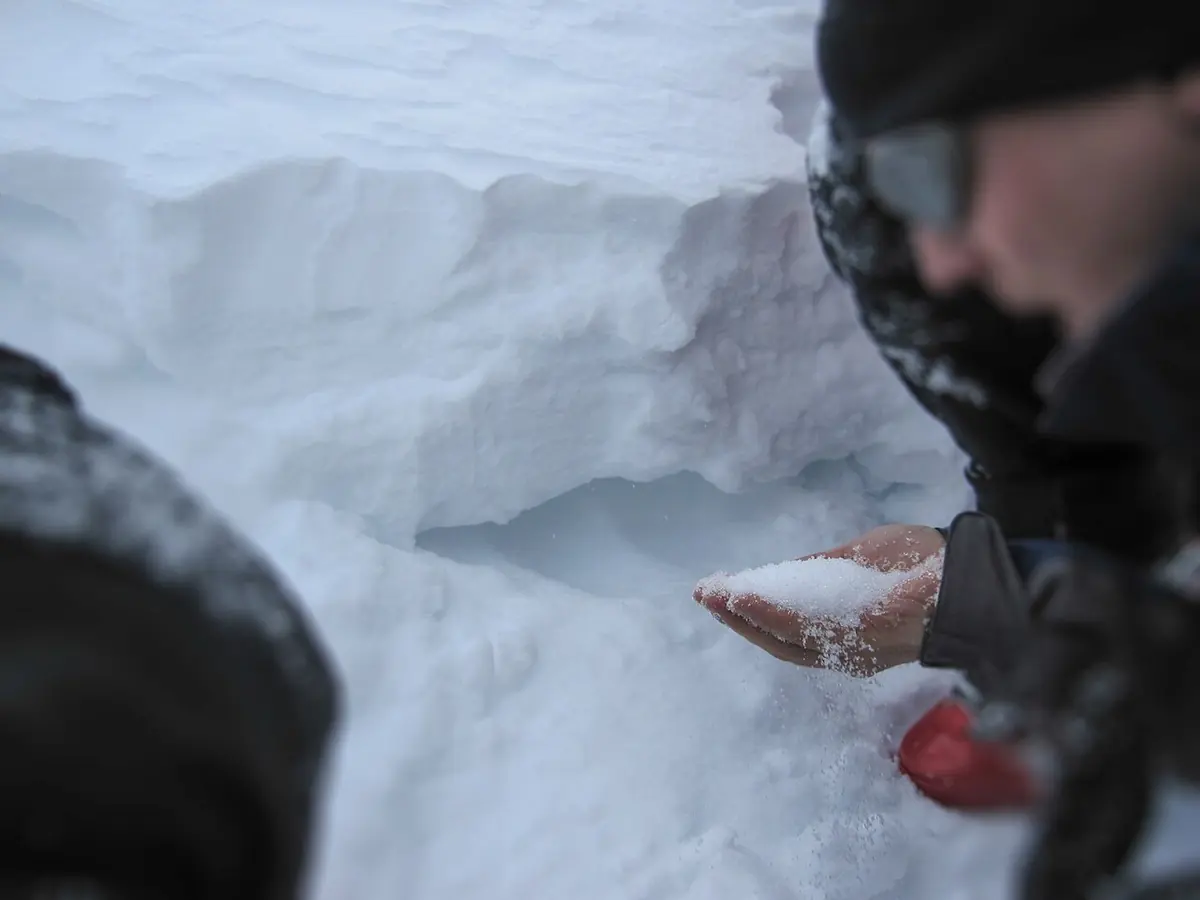
The German term translates roughly as “old snow problem”, which sounds almost like tidying up. What is meant is a layer of faceted, poorly bonded crystals that sits deep in the snowpack, does not break down for months, and cannot be seen from the surface.
How a weak layer forms
Snow is not a dead material. As long as it lies there its crystals change, and the direction of that change depends on a single quantity: the temperature gradient within the snowpack.
The ground beneath a snowpack is always around 0 degrees. The snow insulates it against the cold above, and heat from the earth holds it at freezing point. The surface, by contrast, follows the air. On a clear December night that is quickly minus 15 or minus 20.
Between those two points lies a gradient, and water vapour migrates up through it. If the gradient is small, crystals bond to one another and the snowpack strengthens. If it is large, large faceted crystals grow instead, stacked on one another like loose crockery. As a rule of thumb: from around 10 degrees of difference per metre of snowpack the process tips in that direction.
The part almost nobody expects
That brings in a quantity most people place wrongly: the depth of the snowpack itself.
The gradient is the temperature difference divided by the thickness of the snowpack. The same cold night acts four times as strongly on 50 centimetres of snow as on two metres.
That is exactly what happened in the winter of 2025/26. Little snow fell in late November, and a long anticyclonic spell with clear, cold nights followed well into December. For six weeks the gradient worked on a thin pack. What formed then lay at the bottom of the snowpack for the rest of the winter.
Why it does not go away
Other avalanche problems heal with time. Fresh wind slab settles within days, new snow bonds to its bed surface, wet conditions refreeze overnight. The same rule of thumb applies to all of them: waiting helps.
With a persistent weak layer it does not.
The layer sits at the bottom, often under a metre of snow or more. Down there it is decoupled from the surface. Sun, wind and warmth do not reach it, and the weight of the snow above does not compact it, only loads it. It can outlast weeks and months, and in an unfavourable winter it outlasts the whole season.
That explains an observation from last winter which is otherwise almost unheard of: from 10 January to 22 February, human-triggered avalanches were reported in Switzerland every single day. Six weeks in a row, without one quiet day in between.
Why it catches the experienced
The five avalanche problems distinguished by the European avalanche warning services are not equally hard to recognise.
| Problem | How you recognise it |
|---|---|
| New snow | by the amount, visible and measurable |
| Wind slab | by wind, cornices, deposits in the terrain |
| Wet snow | by temperature, time of day, wet snow |
| Gliding snow | by open cracks in the slope, visible |
| Persistent weak layer | not at all, at least not from outside |
Four of the five leave traces at the surface. You can see where the wind has shovelled the snow. You can see glide cracks. You can feel it when the snow turns wet.
With a persistent weak layer there is none of that. The slope looks like any other.
“These persistent weak layer problems are extremely difficult for backcountry users to assess, because even experts cannot determine where the snow might release, since the weak layer is not visible at the surface.”
Benjamin Zweifel, SLF
The decisive phrase is “even experts”. And with it, the most striking feature of last winter explains itself: a large share of the victims were experienced ski tourers and freeriders with local knowledge.
That is neither coincidence nor recklessness. Experience in the terrain consists largely of reading signs: wind direction, deposits, snow surface, sounds. With a persistent weak layer that entire toolkit fails, because there are no signs. Anyone relying on their own observation is, in this one case, relying on an instrument that shows nothing. Those with little experience, and who are therefore cautious anyway, fall into this trap less often.
Then there is the second catch: a persistent weak layer can be skied repeatedly without anything happening. The slope carries ten tracks, and the eleventh releases it. Which is why the argument “others have already been through here” works particularly badly in this case.
What can be learned from it, and what cannot
A persistent weak layer winter announces itself early, before the season even starts. If little snow falls in November and two cold, clear weeks follow, the foundation for the whole winter is laid. That information appears in every avalanche bulletin from December onwards, and it sometimes stays there for months.
What cannot be derived from it is the assessment of an individual slope. That is precisely the hardness of this problem: it is well described at the level of a region and practically unassessable at the level of a single slope. How to deal with that is the material of a training course and not of a magazine article, and we are not going to pretend otherwise here.
How the winter of 2025/26 looks in figures is set out in our avalanche review. Why danger level 3 of all levels claims the most victims is explained in the piece on the five avalanche danger levels.
Sources and caveats
- SLF, assessment of the winter of 2025/26 and of the formation of the weak layer: temperature gradient between around 0 degrees at the ground and minus 5 to minus 20 at the surface, forming large, poorly bonded crystals. Quotation from Benjamin Zweifel from the same source. Human-triggered avalanches on every day from 10 January to 22 February 2026.
- EAWS (European Avalanche Warning Services), the five typical avalanche problems: new snow, wind slab, persistent weak layer, wet snow, gliding snow.
- European tally 2025/26: 146 deaths, 70 the previous winter, twenty-year mean 104.35. The warning services consistently name the deep weak layer from the early winter as the cause.
- The gradient calculation in the chart is our own and deliberately simplified: it assumes an even temperature distribution across the whole snowpack. In reality the gradient is not constant, and the threshold of 10 degrees per metre is a rule of thumb rather than a sharp boundary. The relationship itself, thinner pack means steeper gradient, is unaffected by this.
- On the share of experienced people among the victims we have assessments from the warning services, not a counted statistic. We therefore report it as an observation and not as a rate.
This piece explains a mechanism and is not training. Assessing avalanche danger in the terrain is learned from the SLF and the SAC.