The heat summer of 2026 has produced a run of closures and cancellations across the Alps that is unusual in its density. Here is the picture as of 13 August, with a distinction the reports often blur: closed and advised against are not the same thing.
Mont Blanc: normal route effectively shut
On the French normal route up Mont Blanc, the Tête Rousse hut and the Goûter hut are closed indefinitely. Both are indispensable for the ascent; without them the route is not viable for ordinary climbers.
The reason is the Grand Couloir du Goûter, a rockfall gully that has always been the most dangerous section of the route and whose condition has deteriorated further through the heatwaves of recent weeks. The municipality of Saint-Gervais-les-Bains has had booked ascents cancelled. On the Italian side, guides had already suspended summit trips earlier.
Matterhorn: cancelled, but not closed
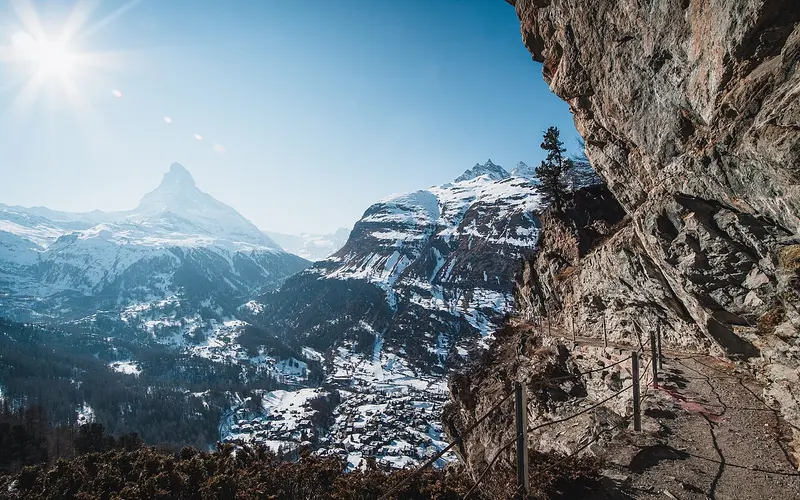
In Zermatt the guides’ office has cancelled all Matterhorn ascents until further notice. The trigger was a series of rockfall incidents on the Hörnli ridge in which several roped parties were hit; in one case a guide had to be flown out by helicopter. On the Italian south side, guides had already stopped after a larger failure.
The difference from Mont Blanc matters: the Hörnli ridge is not closed. The Zermatt guides reject route closures on principle, and in Switzerland it has happened exactly once, in 2003 after a rock failure, then for a few days.
Anyone who goes anyway is doing so legally and at their own risk. That is precisely the point of contention: without guides, people keep climbing, some with little experience, dislodging stones onto those below.
Oeschinensee: 1500 cubic metres, south shore still closed
On Saturday 8 August, shortly after 13:30, a block of around 1500 cubic metres came away from the Spitze Stei above Oeschinensee near Kandersteg. Videos showed walkers running from the lake shore.
The notable part is less the fall than what preceded it: the block had been flagged in the situation report of the previous day. It had lately been moving at around six centimetres a day, while the flank as a whole creeps at about one centimetre a day.
Residential areas were not at risk according to the municipality. The southern shore area remains closed until further notice, as does the section above the Bärentritt. The exclusion zone is dimensioned for failures up to 200,000 cubic metres, a hundred times what came down on 8 August.
The Spitze Stei has been monitored since 2018. In August 2022 around 10,000 cubic metres came off the same flank. That figure is currently circulating in reports about the recent event, but it belongs to 2022.
Two routes above Swiss ski areas moved
Less noticed, but closer to home for us: two classic high routes had to be rerouted because of rockfall, both above areas in our dataset.
- On Piz Palü above Diavolezza, the normal route was shifted west.
- On the Lagginhorn above Saas-Grund, the route was changed to avoid failure zones.
And the glaciers
Summer ski areas were hit earlier. Zermatt stopped summer operation in late July because meltwater was threatening the stability of the lift pylons on Plateau Rosa. Saas-Fee followed on 10 August. The freezing level sat at times just below 5000 metres, and because it barely froze at night, conditions on the Theodul glacier deteriorated quickly.
Why this is all happening at once
The common factor is thawing permafrost, frozen ground whose ice both glues the joints in the rock together and seals them. Remove it and the rock loses purchase while becoming permeable, and water entering the joints acts as a wedge.
The numbers are unambiguous: at ten metres depth Swiss permafrost has warmed by more than 0.8 degrees since 2014, and at Schilthorn the active layer failed to refreeze for the first time at a monitoring site in winter 2024.
What usually gets lost: events lag the warming, because heat takes years to penetrate rock. Today’s rockfall belongs to the warming of the year before last. And not every failure is permafrost: in the Blatten landslide of May 2025 the source area lay more than 500 metres above the permafrost limit. The Lauchernalp ski area in the same valley is, according to the lift company, affected neither in access nor in operation.
The full explanation with the measurement series is in our piece Why Alpine rock is falling apart: permafrost, explained.
Sources
- Municipality of Kandersteg, Spitze Stei situation reports, 7 and 8 August 2026.
- Statements from the guides’ offices in Zermatt and Courmayeur, and the municipality of Saint-Gervais-les-Bains.
- German Alpine Club on the effects of the 2026 heat summer on mountain sport, including the route changes on Piz Palü and the Lagginhorn.
- PERMOS, Swiss Permafrost Monitoring Network, 2025 assessment.
- On the end of summer skiing, see our reports on Zermatt and Saas-Fee.
As of 13 August 2026. Closures change quickly; the binding source is always the municipality, the hut or the guides’ office.