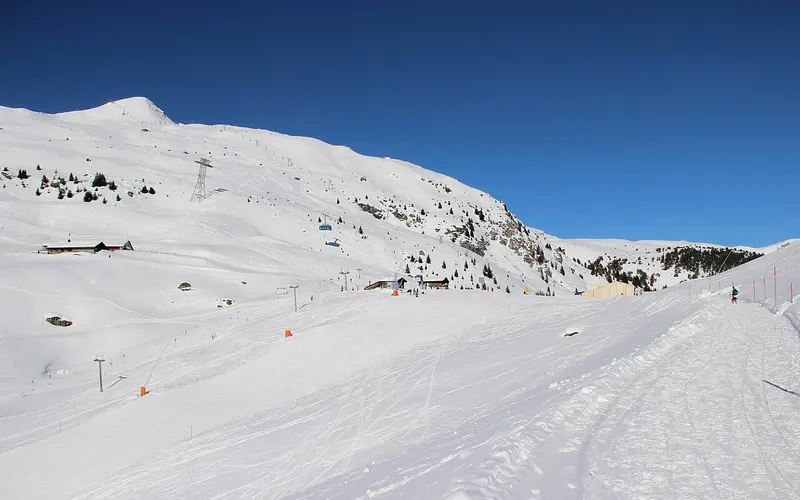
The winter of 2025/26 was short of snow. Mean snow depths across the Alps were among the five lowest since 1991, the northern Alps saw the second driest winter since 1991 and the southern Alps the driest of all. In December, temperatures above 1500 metres ran 3.4 degrees above the mean.
The obvious expectation would be a collapse. What actually came out is more interesting.
The figure everyone quotes
Minus 2 per cent of first entries compared with the previous winter. That is the result of the season monitoring by Seilbahnen Schweiz, collected from over 140 companies which together account for 90 per cent of the industry’s turnover.
Minus 2 per cent after a winter like that is remarkably little. And it conceals a season profile that was extreme in itself.
The profile: from minus 37 to plus 28
The start was a disaster: by mid-December, 37 per cent of guests were missing. The Christmas holidays, the strongest revenue block of the year for many resorts, came in 14 per cent below the previous year. The February sports holidays almost reached the previous year’s level, because February was the only month with precipitation above the 1991 to 2020 average.
And then it turned. From 16 March, 28 per cent more, and in April 23 per cent more than the year before, and that despite an early Easter which shortened many resorts’ seasons.
So anyone reading only the “minus 2 per cent” headline misses the actual story: this season was rescued in its final six weeks.
Altitude decided it, as always
| Altitude | First entries vs previous year |
|---|---|
| above 2000 m | level with previous year |
| 1500 to 2000 m | −3 % |
| below 1500 m | −6 % |
It is the same pattern as always, and it was unusually sharp this winter. Resorts high up had a season. Resorts low down had an opening that never happened and then too little time.
A second cut shows the same thing from another angle: destinations with staying guests or a mixed clientele came in at plus 1 per cent, pronounced day-trip areas at minus 3. Someone already in a hotel skis even in mediocre weather, because they are there. The day visitor looks out of the window on Saturday morning and stays home.
The regions
| Region | First entries |
|---|---|
| Valais | +2 % |
| Vaud and Fribourg Alps | +2 % |
| Ticino | +1 % |
| Central Switzerland | −5 % |
| Eastern Switzerland | −9 % |
Eastern Switzerland, with its comparatively low-lying resorts, took the winter hardest. Valais, where the large resorts all sit high, finished in positive territory.
The comparison to treat with care
Alongside the 2 per cent decline, Seilbahnen Schweiz also cites a plus of 13 per cent against the five-year average. That figure was widely quoted, and it is correct, but it needs a footnote.
The five-year average for 2025/26 covers the winters from 2020/21 to 2024/25. That includes the pandemic winter of 2020/21, when Swiss resorts were open but without foreign guests and without mountain restaurants. An average containing an exceptional winter like that sits lower than a normal one, and a gain measured against it looks larger than it is. That is our reading, not the association’s.
And now the contradiction
While the lifts lost 2 per cent, the hotel sector reported a record for the same November-to-April winter season: 18.7 million overnight stays, up 1.1 per cent. Domestic demand rose 1.6 per cent, foreign demand 0.5 per cent.
A record winter in the beds and a loss on the lifts, in the same country, over the same period. It looks like an error. It is not, and the resolution is in the regional table from the Federal Statistical Office:
| Tourism region | Overnight stays vs previous year |
|---|---|
| Ticino | +7.2 % (+49,000) |
| Lake Geneva region | +2.5 % (+42,000) |
| Zurich | +1.6 % (+51,000) |
| Valais | +0.7 % (+15,000) |
| Grisons | +0.1 % (+2,800) |
The record came from the cities and from Ticino, not from the ski resorts. Grisons, the country’s largest ski canton, gained 2800 overnight stays. That is 0.1 per cent, which is statistical standstill. Zurich alone brought almost twenty times as many additional nights as Grisons.
The Swiss hotel sector had a record winter. Swiss ski resorts did not.
A second contradiction, harder to resolve
There is one point where the two statistics genuinely run against each other, and we do not want to smooth it over.
The hotel figures show a strong increase from December to February and a decline from March onward. The cableways report exactly the opposite: a weak December, a strong March and April.
Three explanations suggest themselves, and they do not exclude one another.
- Different things are being counted. Overnight stays cover the whole of Switzerland including city breaks, business travel and conferences. First entries only count someone passing through a lift turnstile.
- Beds are booked early, ski days decided spontaneously. Someone who books in October for Christmas turns up even if there is no snow in December; they simply ski less. Conversely the day visitor decides the evening before in March, and never appears in any hotel statistic.
- Easter fell early. That shifts nights between March and April and makes month-on-month comparisons unreliable across this spring generally.
Point 2 is the most plausible explanation for the divergence, and it fits what Seilbahnen Schweiz says about the difference between staying-guest and day-trip areas. That does not make it proven. We record it as a reading, not a finding.
And revenue?
Here we have to pass, at least in part. No separate turnover figure for the 2025/26 winter season was published. What is known is the industry’s turnover for the 2025 calendar year: 1.8 billion francs, of which roughly half comes from winter, a fifth from summer and 18 per cent from food and lodging.
What can be said: a 2 per cent drop in entries does not automatically mean a 2 per cent drop in revenue. Prices have risen, dynamic tariffs shift revenue into the days in strongest demand, and a strong March and April sell more full-price day tickets than a strong December does. Anyone reading the individual cableway companies’ financial statements in the autumn will therefore probably see friendlier figures than the 2 per cent decline suggests. We will follow up once the annual reports are out.
What this means for next winter
Three lessons from this season.
First: the start of the season has become the weak point, not the end. Minus 37 per cent to mid-December, then plus 28 from mid-March. For two decades spring was the shaky part of the winter. Now it is the beginning.
Second: 1500 metres is the altitude where it hurts. Not 2000, not 1000. Below 1500 metres this winter was a loss-making exercise; between 1500 and 2000 it just about held.
Third: having guests staying in the village is more stable than waiting for day trippers. Plus 1 against minus 3, in identical weather.
Where things go from here, and when resorts plan to open this winter, is covered in our winter forecast and in the overview of opening dates for 2026/27.
As of 10 August 2026. The figures refer to the completed 2025/26 winter season. The assessment of the five-year average and the explanations for the divergence between the two statistics are our own reading and are marked as such.
Sources: Seilbahnen Schweiz, season monitoring April 2026 and the closing balance of 6 May 2026 (first entries, season profile, altitude bands, regions, guest mix); Federal Statistical Office on the 2025/26 winter season in the hotel sector (18.7 million overnight stays, regions, monthly profile); German Weather Service on the Alpine climate in the 2025/26 winter half-year (snow depths, precipitation deficits, December temperature); industry turnover 2025 per Seilbahnen Schweiz.