Update, 20 September 2026: “Until further notice” meant twenty days. On 4 September S.I.F.A.S. resumed operations on the Stelvio, daily from 06:30 to 12:00. On 19 September Val Senales joined it. The headline of this article describes 15 August, not today.
It is one sentence on a website, and it marks the end of something.
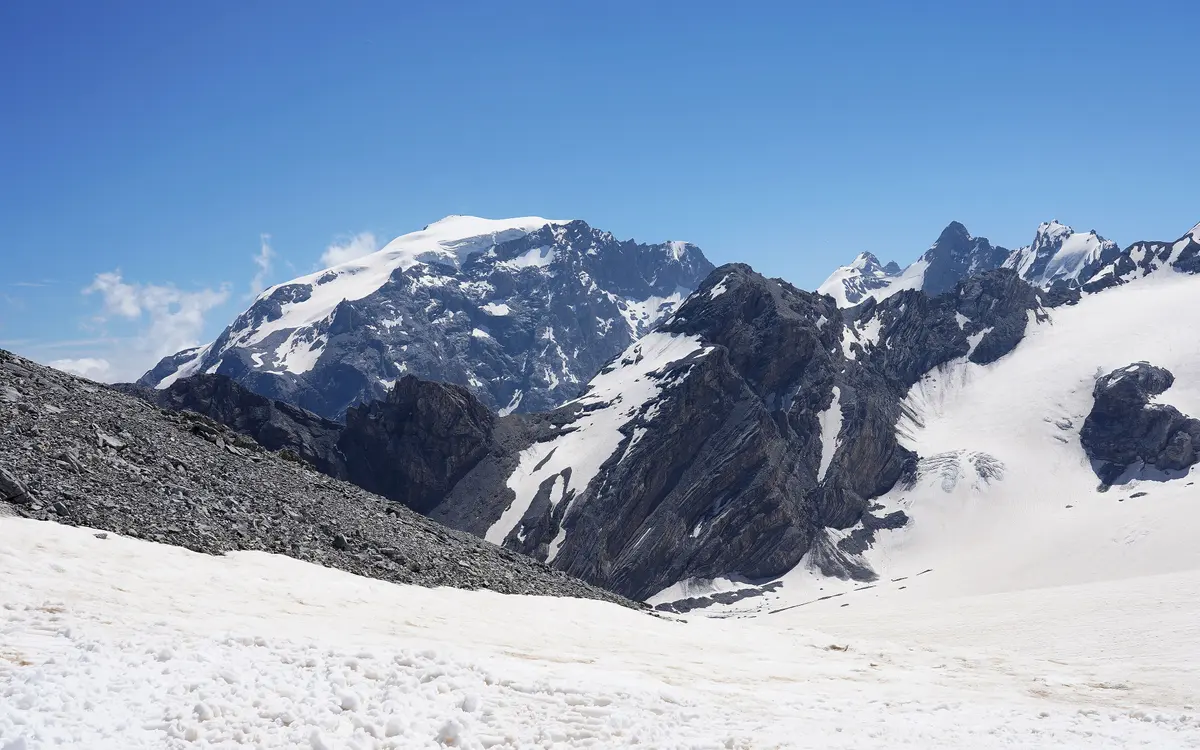
S.I.F.A.S., which runs the lifts on the Stelvio pass, announced today that from 15 August 2026 it is suspending skiing on the Gentili glacier until further notice.
What the operator says
The notice is unusually candid for a lift company. It gives three reasons, and none of them is a lack of snow:
Persistent heatwaves, recorded even at high altitude; the absence of nocturnal cooling and refreezing of the snowpack; frequent thunderstorms, which have further degraded the state of the glacier.
And further:
These factors make it impossible to guarantee the usual standards of quality and, above all, of safety that summer skiing requires.
The cable car to the glacier keeps running, explicitly so. Anyone who wants to go up still can. They just cannot ski there.
The word “temporary” appears in the notice’s title, and it deserves to be taken seriously: S.I.F.A.S. is hoping for falling temperatures and is explicitly keeping a reopening in view. Whether it comes is up to the weather of the next few weeks.
Why Stelvio in particular marks the end
Stelvio is not a ski area like the others. It is a pure summer ski area with no winter operation at all, because the pass road is closed in winter. The season runs from late May to early November, and then it is over.
For Zermatt or Saas-Fee a summer pause is annoying but survivable: winter comes anyway. For Stelvio the summer is the entire season. When operations stop there, everything stops.
That is also why it was the last area still running this summer. An operation with nothing else holds out longer.
The chronicle of this summer
Six areas, six dates, eleven weeks.
The remarkable part is not that areas close in August. That happens. The remarkable part is that all of them closed, and that the reason given is almost everywhere the same.
But wasn’t everything shut in 2022 as well?
That is the first objection, and it is a fair one. Summer 2022 was the worst on record for Alpine glaciers, and the list of failures reads almost like today’s:
- Les 2 Alpes closed on 10 July.
- Val d’Isère never opened its glacier at all.
- Tignes stopped on 25 July, a month earlier than planned.
- Stelvio stood still for two months in the middle of high summer, and Zermatt suspended operations for around 50 days.
And yet 2022 was not the same. One operation kept running: the Hintertux glacier. 2022 was its last year of full year-round operation, 365 days, without a single pause. Anyone determined to ski in August 2022 could do so in the Zillertal.
That fallback is precisely what has gone. Hintertux gave up year-round operation across four summers: individual closure days in 2023, six weeks from mid-August in 2024, two months in 2025, and on 26 July 2026 operations ended and were not resumed. The full story is in Hintertux gives up year-round skiing.
So the difference between 2022 and today is not the heat. It is that the last fallback has disappeared. In 2022 almost everything failed and one area held. In 2026 everything fails.
How the two years compare on the glacier figures themselves we set out separately: is 2026 worse than 2022? In short: not for the ice, but yes for ski operations.
It is not the snow, it is the night
Lay this summer’s four notices side by side and a pattern appears.
Zermatt stopped on 31 July because meltwater was threatening the stability of the lift pylons on Plateau Rosa. Saas-Fee followed on 10 August because pistes and glacier infrastructure no longer met the safety standards. Stelvio now cites the missing nocturnal cooling.
Not one of the notices says there is too little snow.
The decisive process is a different one. A glacier that carries skiing in summer needs the night. It has to refreeze, so that the surface bears weight in the morning and so that meltwater is not running through the ice around the clock. When the freezing level sits at 5000 metres for weeks, exactly that fails. The glacier no longer freezes through, the piste turns to slush by mid-morning, and underneath, water works away where pylons are anchored.
It is the same mechanism that put Mont Blanc, the Matterhorn and Oeschinensee in the headlines this summer. We explained it separately: why Alpine rock is falling apart.
What it means for Switzerland
For Swiss skiers little changes immediately, since summer skiing here had already ended on 10 August. The significance lies elsewhere.
Summer skiing in the Alps has been shrinking for over fifty years. In the 1970s the lifts turned on dozens of glaciers in July. A handful were left at the end, and this summer, none. Which areas once existed and when they stopped is set out in our chronicle of discontinued summer ski areas.
In practice the first to feel it are not holidaymakers but the race teams. Summer training on snow happens in the Alps or not at all; the alternative is the southern hemisphere at several times the cost. When Zermatt shut at the end of July the teams moved to Saas-Fee, where capacity was already tight. Now there is nowhere left to move to.
What is still open
Three things we do not know, and we would rather write them down than paper over them.
Whether it reopens this year. “Until further notice” means exactly that. At Stelvio the season officially runs to early November, so more than two months remain. If it cools and the glacier refreezes at night, operations can come back.
Whether 2026 is the exception or the beginning. One summer is not a trend. But it is the summer in which Hintertux gave up year-round operation, and that decision was not made because of a heatwave; it came after four summers of ever longer pauses.
How the others will play it. Zermatt reassesses daily. Saas-Fee has closed the book on this summer. Whether any of them opens again in September depends on the weather and on whether the effort pays for a few weeks.
Sources
- S.I.F.A.S. S.p.A. (Società Impianti Funiviari Alto Stelvio), notice “Temporary suspension of skiing on the Stelvio glacier (Gentili)”, published 14 August 2026 on its own website. The quotations are from that notice, translated from the German version.
- Zermatt Bergbahnen, summer operations halted 31 July 2026.
- Saastal Bergbahnen, halted from 10 August 2026, last day of operation 9 August.
- Zillertaler Gletscherbahnen, end of year-round operation on the Hintertux glacier, 26 July 2026.
- Les 2 Alpes: published summer season 31 May to 5 July 2026, mornings only. Tignes: Grande Motte, 20 June to 19 July 2026.
- On summer 2022: Les 2 Alpes closed on 10 July, Tignes on 25 July after cutting the season short, Val d’Isère did not open its glacier, Zermatt shut at the end of July and stayed closed until mid-September, and Stelvio closed temporarily. Hintertux ran through that summer without a pause; the record of its pauses from 2023 to 2026 is in our piece on the end of year-round operation.
As of 14 August 2026. The statement that nothing is running refers to the Alps and to the areas we track. Should a lift somewhere still be turning, we will correct this rather than leave it standing.