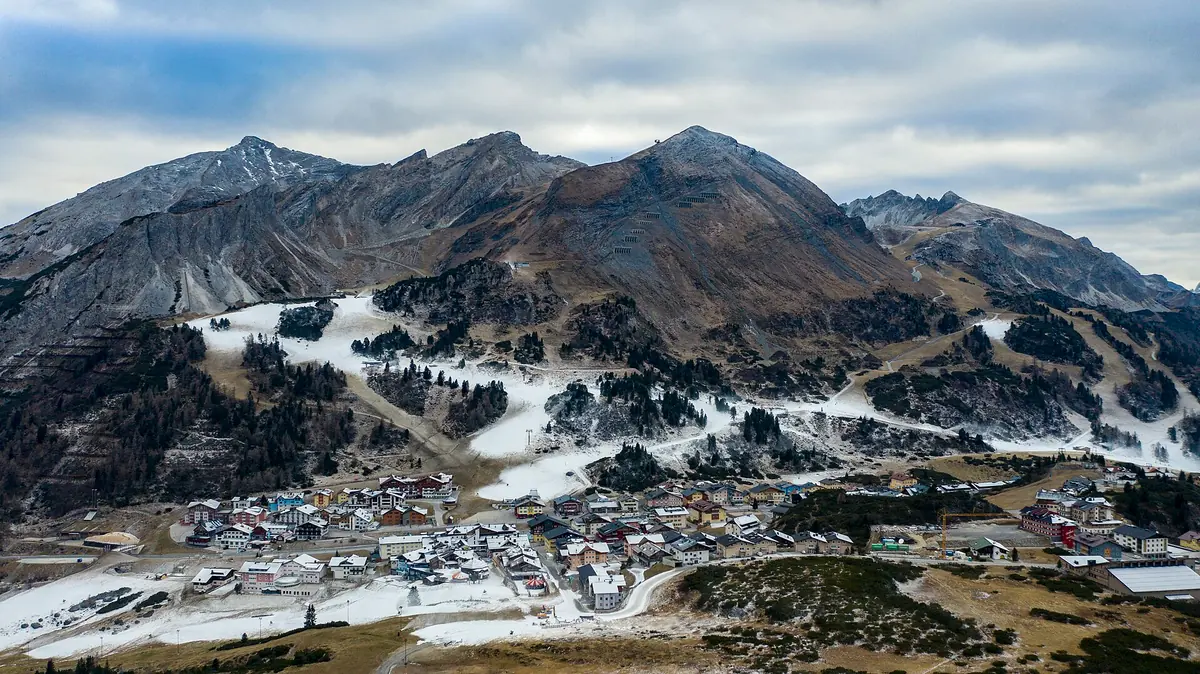
Two sentences about Sölden, both true and seemingly contradictory. First: on 24 and 25 October the alpine World Cup is due to open the season on the Rettenbach glacier, women’s giant slalom on Saturday, men’s on Sunday. Second: the glacier ski area above it still has no opening date.
That is not a contradiction. They are two different jobs, and one of them is very much smaller than the other.
What is possible at 2,900 metres
We pulled the outlook for race altitude, sixteen days, calculated at 2,900 metres. The result looks quite different from what happens further down.
129 hours on the race course against 95 hours across all ten Swiss areas put together. The ten average ten hours each; the best of them manages 23. For reliable production, meaning minus four degrees wet-bulb, the Rettenbach glacier has 86 hours left, while five of the ten areas below have none at all.
The turn comes on 5 October. Until then the minimum at 2,900 metres stays above freezing; after that it drops below, reaching minus five degrees on 7 and 8 October. Daytime highs stay above freezing for all sixteen days, between 2.8 and 11.8 degrees. So the snow gets made at night, and that is enough.
What does not appear in this forecast: new snow. Not one centimetre in sixteen days, on 4.3 millimetres of precipitation in total. It turns cold, but nothing falls.
Why that is still enough for a race
Because the snow is already there. On the steep section of the course lie three large snow depots, stored under fleece through the summer. On 25 September the course chief, Isidor Grüner, said there were “sufficient snow reserves to organise the races despite the record-warm summer”.
How that method works, and why a heap of snow survives a summer, is in our piece on snowfarming.
What Sölden actually said
Precision is worth it here, because a few things are being mixed up.
Sölden has not postponed a season start, because it never announced one. For weeks the area has said “early October” and has never named a day. Its own site carries the World Cup date prominently; an opening date for the glacier ski area is not there. Some overviews list 2 or 4 October, and until today our own data showed 2 October as well. Neither comes from the lift company itself, so we no longer show a date.
The area that called off is Kaunertal. On 22 September, four days before its own date, giving persistently high temperatures as the reason. There is still no new date. The two announcements are being conflated at the moment, not least because both areas sit in the same corner of Tyrol.
This is how things stand in Tyrol and South Tyrol today:
| Area | Status |
|---|---|
| Pitztal | open since 26 September, 15 cm of new snow reported |
| Val Senales | open since 19 September |
| Stelvio | open since 4 September |
| Sölden | ”early October”, no day named, World Cup on 24/25 October |
| Stubai | 9 October planned, explicitly conditional |
| Hintertux | ”probably late September”, no fixed date |
| Kaunertal | start called off, no new date |
What this means for the question
Four weeks out from the race, the figures look good: the cold nights arrive from 5 October, the depots are in place, and the course chief says it is enough. What will be missing is new snow beside the course, and with it a ski area you could use after the race.
None of that is certain. A sixteen-day forecast reaches to 12 October; the race is twelve days later. And how little the later days of such a forecast are worth we found out ourselves this week: the cold window that sat on 4 October on 22 September sits on the 9th today. More on that in our snowmaking analysis.
Read on: Too warm to make snow · Snowfarming: how a heap of snow survives the summer · Six glaciers have a date · Where can you ski in October?
Sources and method
- World Cup date: soelden.com, event page for the AUDI FIS Ski World Cup Opening, 24 and 25 October 2026, retrieved 27 September 2026.
- Snow depots and quote: report by skinachrichten.de of 25 September 2026, quoting course chief Isidor Grüner. Three depots on the steep section.
- Weather data: Open-Meteo, which combines the MeteoSwiss and DWD models, retrieved 27 September 2026. The Rettenbach glacier was calculated at 2,900 metres, the Swiss areas at 2,000. The altitude is fixed because otherwise the model uses the terrain height of its grid point, which in high mountains is often several hundred metres off.
- Status of the other glaciers: notices on pitztaler-gletscher.at, kaunertaler-gletscher.at, stubaier-gletscher.com and hintertuxergletscher.at, retrieved 27 September 2026, plus the overview by snow-online.de of 22 September 2026.
- Checking the figures:
scripts/beschneiung-pruefen.mjsin the repository. Running it again gives today’s state.