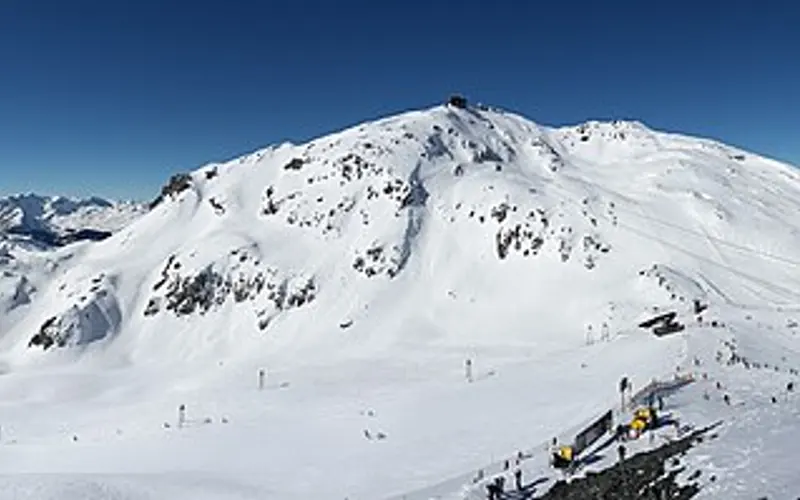
Competitive freeriding has one mountain on which everything is decided, and it stands in Valais. The Bec des Rosses above Verbier has hosted the final of the Freeride World Tour since the tour began.
Anyone seeing it from below for the first time understands immediately why the television pictures always come from the same direction: the face is visible in full width from the opposite side. The entire competition plays out within a single frame.
The figures
| Summit elevation | 3,223 m |
| Competition vertical | around 600 m |
| Slope angle | around 43 degrees |
| Role on the calendar | Freeride World Tour final |
For comparison, in degrees of slope angle:
Why this mountain and not another
The Alps have plenty of steep faces. What makes the Bec des Rosses the final is a combination that rarely comes together.
It is complex, not merely steep. An evenly steep face is a test of nerve. The Bec des Rosses is threaded with rock bands, couloirs and ledges, so several lines are possible and none is obvious. That is exactly what the scoring is built on: it rewards not who reaches the bottom fastest but line choice, fluidity, control, airs and technique.
It is fully visible. For a competition judged by a panel and broadcast on television, that is the practical prerequisite. The athletes inspect the face beforehand from the opposite slope, with binoculars, and have to memorise their line. On the face itself much of it can no longer be seen.
It is reachable. Access runs via the Verbier lifts and a climb. That sounds banal but is the reason a competition with judges, safety crews, camera teams and spectators can happen there at all.
The date is rarely fixed
A quirk of this event that regularly confuses spectators: the date is a window, not a day.
The event is scheduled within a multi-day window and run on the most suitable day. What decides it is snow conditions, visibility and the avalanche situation. If both go badly it is postponed, and in some years tour stops are cancelled altogether.
That is not an organisational failing but the only possible design for a competition in unsecured terrain. A race with a fixed start time would only exist at the price of eventually having to start in poor conditions.
What the Olympic decision changes
On 7 July 2026 the IOC added freeride to the programme of the 2030 Winter Games: four medal events, 44 starting places, split equally between women and men. We have assessed the decision separately.
For Verbier that means nothing concrete for now. The venue for the Olympic events has not been determined and will be in France, since that is where the Games are held. The Bec des Rosses remains what it is: the tour final and the benchmark by which the sport measures itself.
What can be foreseen is something else. Olympic status brings attention to terrain that is unskiable for the overwhelming majority of people. A 43-degree face threaded with rock bands is not a place to try things out.
The sentence that belongs here
What is seen on the Bec des Rosses happens under conditions that apply nowhere else: the face is assessed beforehand, the day is chosen, a safety crew stands ready, a helicopter is on site, and every rider has years of experience in exactly this terrain.
None of that applies to an arbitrary slope beside a piste. There the avalanche bulletin applies, and the statistics are sobering: around half of all avalanche deaths occur at danger level 3, that is, on an ordinary sunny winter day. The figures are in our piece on the five avalanche danger levels, and last winter’s tally in the avalanche review 2025/26.
The Bec des Rosses is impressive because it is the exception. It is not a model.
Sources and caveats
- Freeride World Tour, figures for the Bec des Rosses: summit elevation 3,223 metres, around 600 vertical metres of competition face, slope angles around 43 degrees, and its role as the venue of the tour final.
- IOC, admission of freeride skiing and snowboarding to the programme of the 2030 Winter Games on 7 July 2026: four medal events, 44 athletes.
- Piste gradients are guide values. Switzerland has no binding standard for classifying pistes by gradient; the classification rests with the area. The comparison in the chart serves orientation, not classification.
- The 30-degree mark for slab release is the guide value commonly used in avalanche science and not a sharp boundary.
- We deliberately name no individual descents and give no line descriptions. That would be a terrain recommendation, and we cannot take responsibility for one.
- No calendar for the 2027 season was available at the time of writing. We will add it once the tour publishes it.
This piece portrays a competition venue. It is not a terrain recommendation and not training. Anyone skiing off-piste needs a course with the SLF or the SAC and, in case of doubt, a mountain guide.